Trust behavior over aspiration
I use sent mail as the primary evidence base because the voice interview can explain a pattern but cannot overrule repeated real choices.
Evidence-based voice system
My first style guide described the writer I thought I was, while my sent folder kept a much better record of the choices I actually made.
Generates drafts in my actual voice and turns recurring draft-to-sent corrections into candidate lessons without allowing automatic promotion or sending.
The problem
I could generate a draft that satisfied every rule in the first guide and still know immediately I would never send it, which exposed self-assessment as the unreliable narrator in the model.
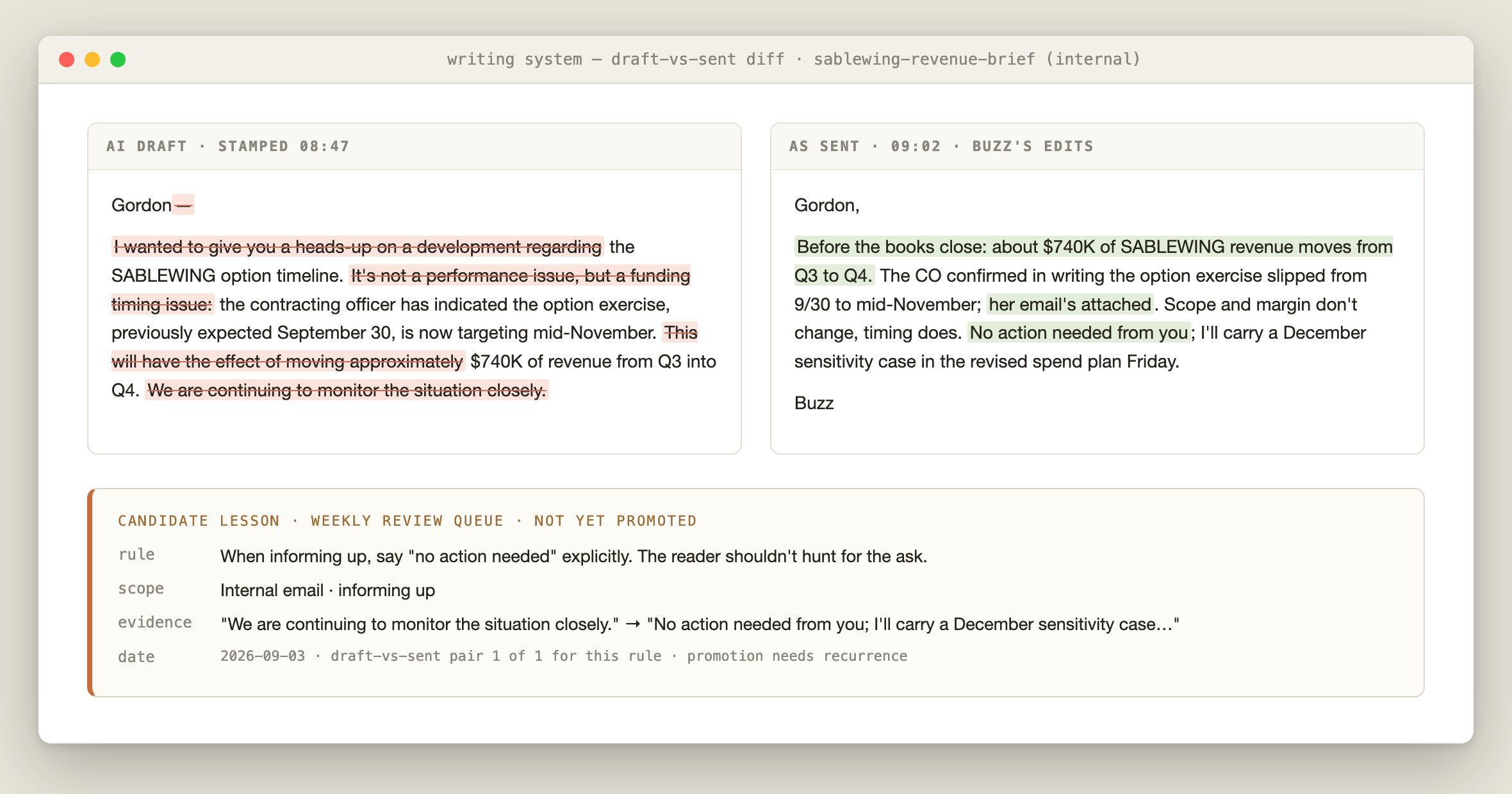
My corrections created another blind spot because useful edits disappeared after each send, while recipient-specific changes could look like durable style rules without a paired record of the draft and final message.
System output against fabricated inputs; no employer data.
Method: see How the evidence was made.The approach
I rebuilt the system against 2,513 sent emails, cross-checked the findings against a structured voice interview, and validated them against held-out real mail, with separate guides preserving the register differences across internal email, external email, internal notes, and public writing.
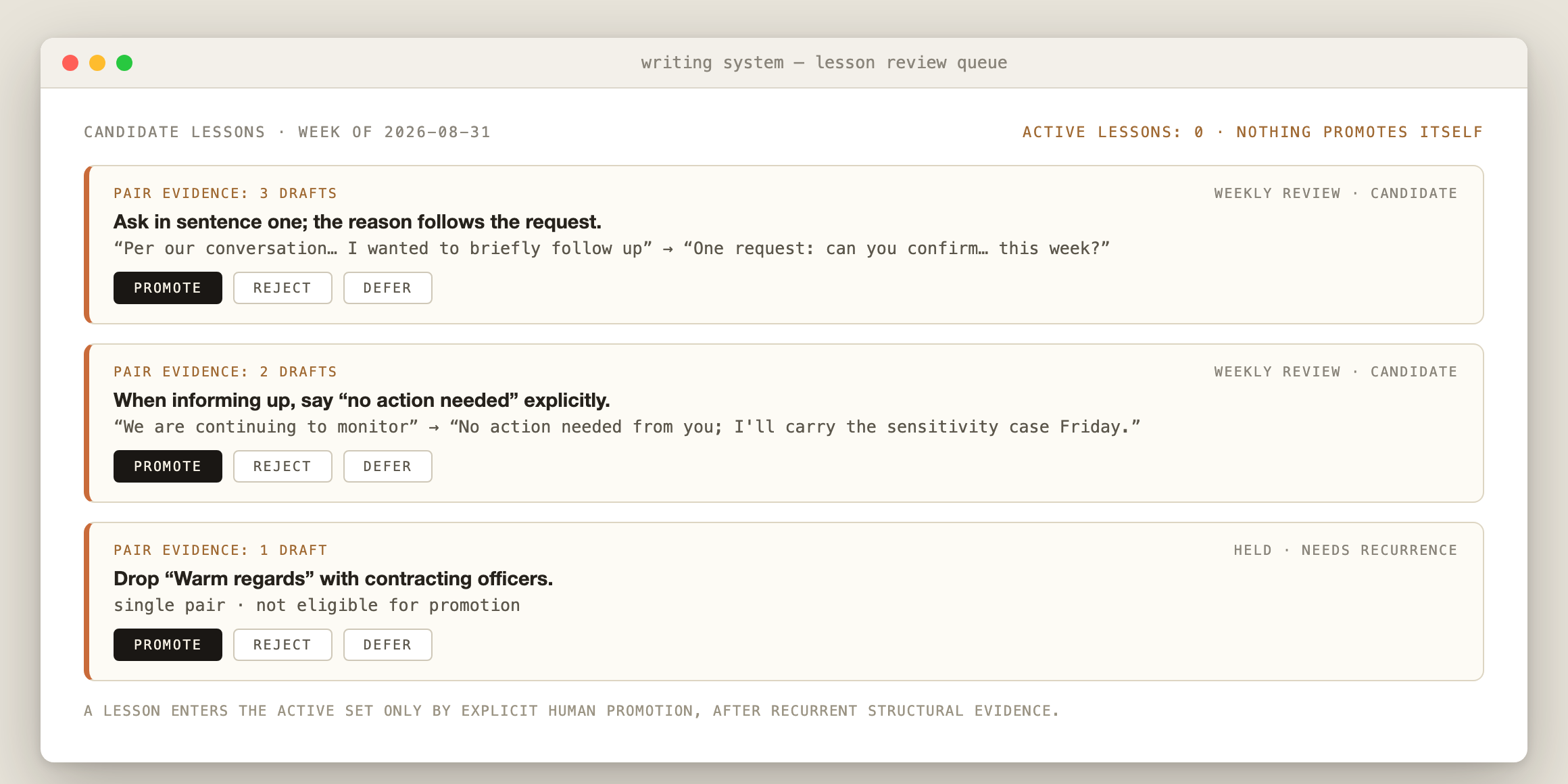
I match stamped drafts to sent messages, redact sensitive details, exclude factual and recipient-specific edits, and require a structural correction to recur before it can become a candidate lesson. An agent with send authority on my mailbox is a category of risk I’m not accepting for a marginal convenience.
Design decisions
I use sent mail as the primary evidence base because the voice interview can explain a pattern but cannot overrule repeated real choices.
I keep separate guides for different registers because one universal model would flatten distinctions the corpus makes clear.
I compare what the system proposed with what I sent so recurrent structural edits become evidence instead of anecdotes.
I let the learning loop report candidate lessons, while changing the canonical voice model or sending a message still requires my explicit decision.
System output against fabricated inputs; no employer data.
Method: see How the evidence was made.Scale and controls
What remains unproven
A large sent-mail corpus can encode old habits as faithfully as good ones. The system reduces self-report bias and captures recurrent corrections, but it still depends on human judgment to distinguish authentic voice from a pattern worth changing.