Separate search from recall
I use different ranking objectives for known-item retrieval and forgotten-connection discovery because one compromise sort order weakens both jobs.
Governed knowledge infrastructure
I built the Second Brain because search could find what I remembered to ask for, while the decisions I most needed to revisit were usually the ones I had forgotten.
I use it across multiple AI assistants to search the record and surface cold knowledge I have forgotten. Curated context, primary records, summaries, and extracted facts keep separate authority, and durable corrections wait for human review.
The problem
I had years of meetings, AI sessions, notes, and interactions carrying more context than I could actively hold, while ordinary search kept rewarding the terms I already knew.
The additional risk is epistemic. If extracted facts, summaries, and source documents lose their distinct authority, an assistant can repeat a derived claim with the confidence of a primary record.
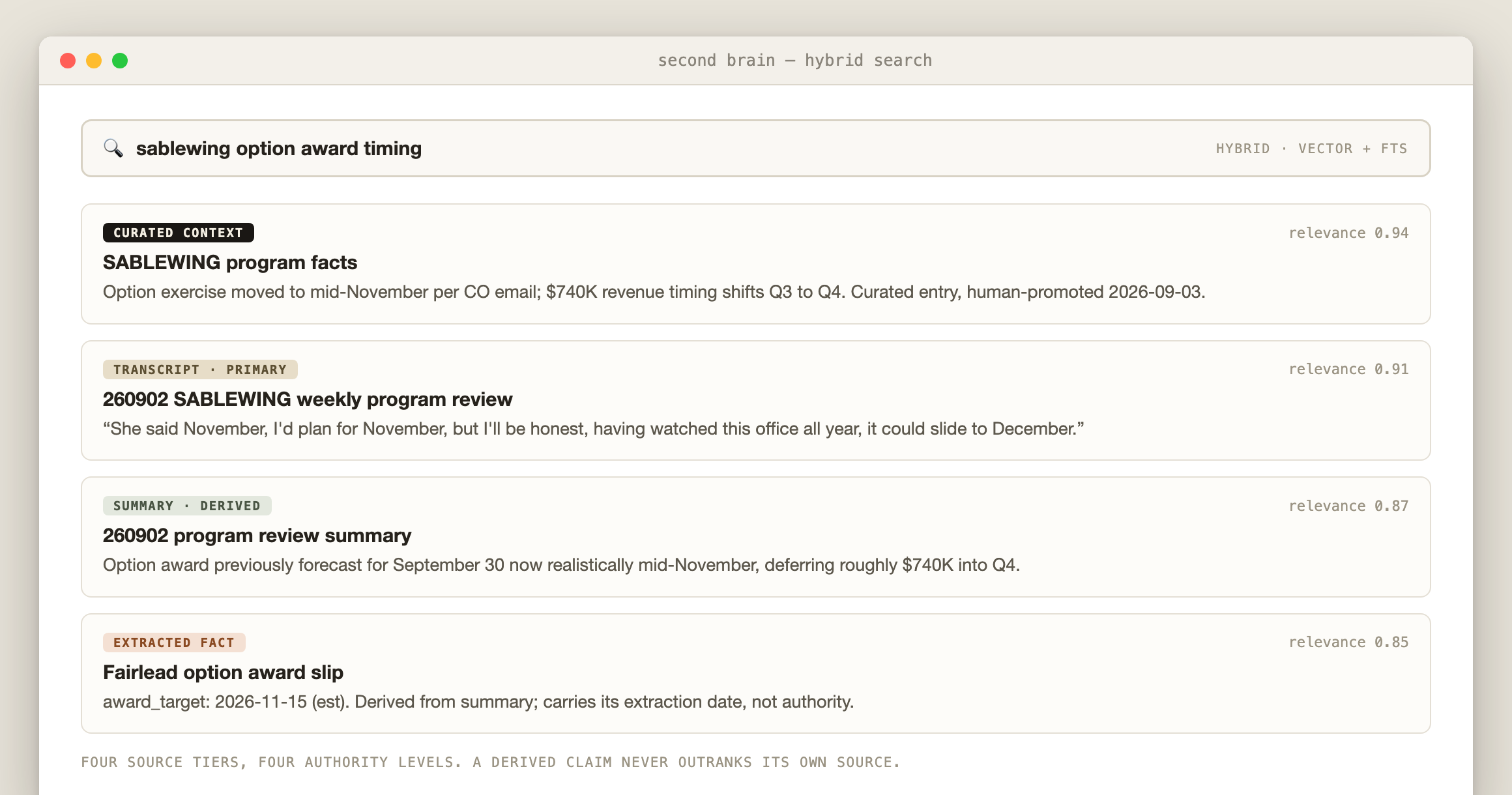
System output against fabricated inputs; no employer data.
Method: see How the evidence was made.The approach
The deployed system holds 27,947 conversation records as of September 14, 2026, and exposes recall, hybrid search, deep research, fact and entity operations, graph summaries, calendar context, and meeting preparation through one interface available to multiple AI assistants.
I keep direct search focused on relevance and give proactive recall a deliberate cold-knowledge bias, while curated context retains authority and every durable correction moves through a human-governed promotion path.
Design decisions
I use different ranking objectives for known-item retrieval and forgotten-connection discovery because one compromise sort order weakens both jobs.
I keep curated context, primary records, summaries, and extracted facts at distinct levels of authority, then let newer or more specific evidence challenge the current view without silently overwriting it.
I stage potential durable corrections for review so promotion, rejection, and deferral remain explicit human decisions with an audit trail.
I built a mobile-first interface around current schedule and action state, while authenticated tools make the same knowledge available inside active AI conversations.
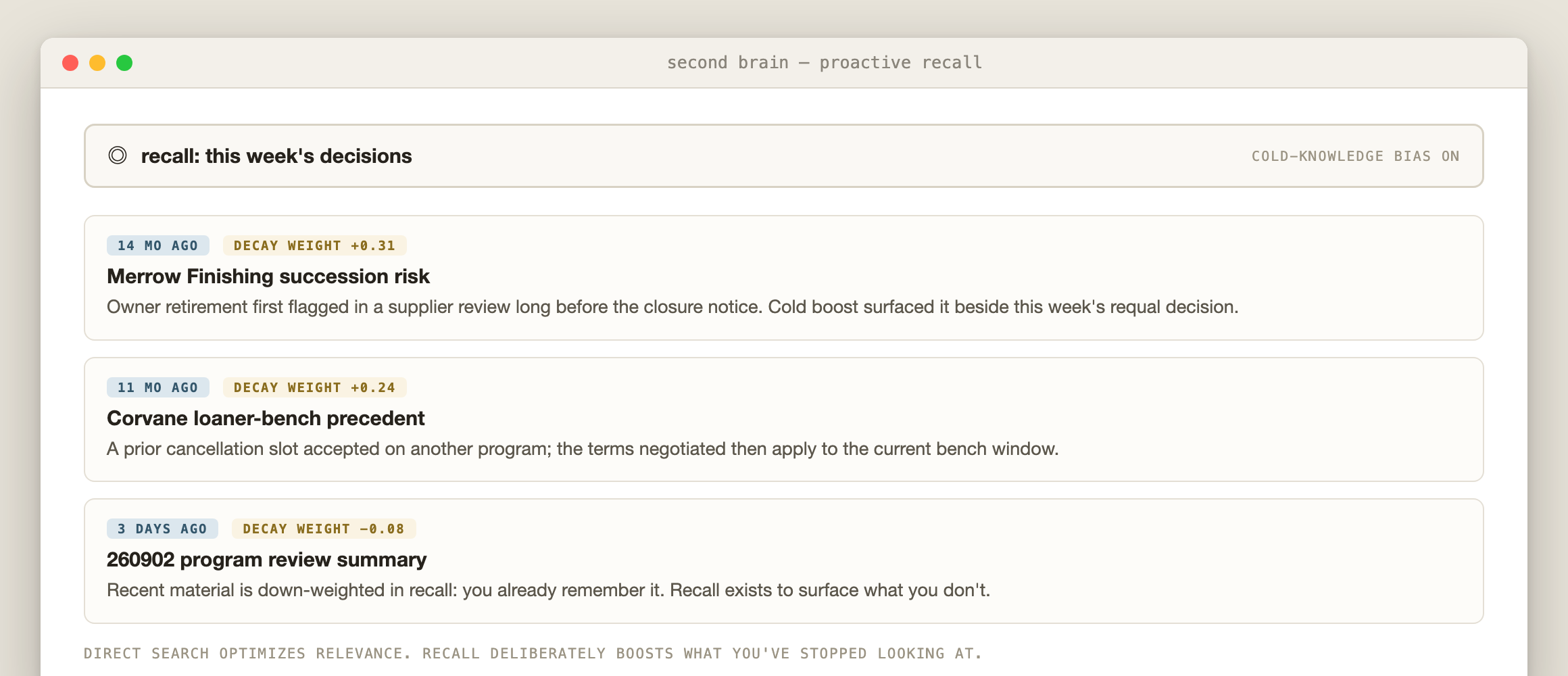
System output against fabricated inputs; no employer data.
Method: see How the evidence was made.Scale
What remains unproven
The conversation total counts stored records; 14,968 carry the database processed flag. The active-fact count excludes 460 superseded records. These counters establish corpus size and processing state. Those counts do not establish recall quality. The harder measure is whether surfaced context changes decisions without increasing false confidence, and that remains an ongoing evaluation problem.